
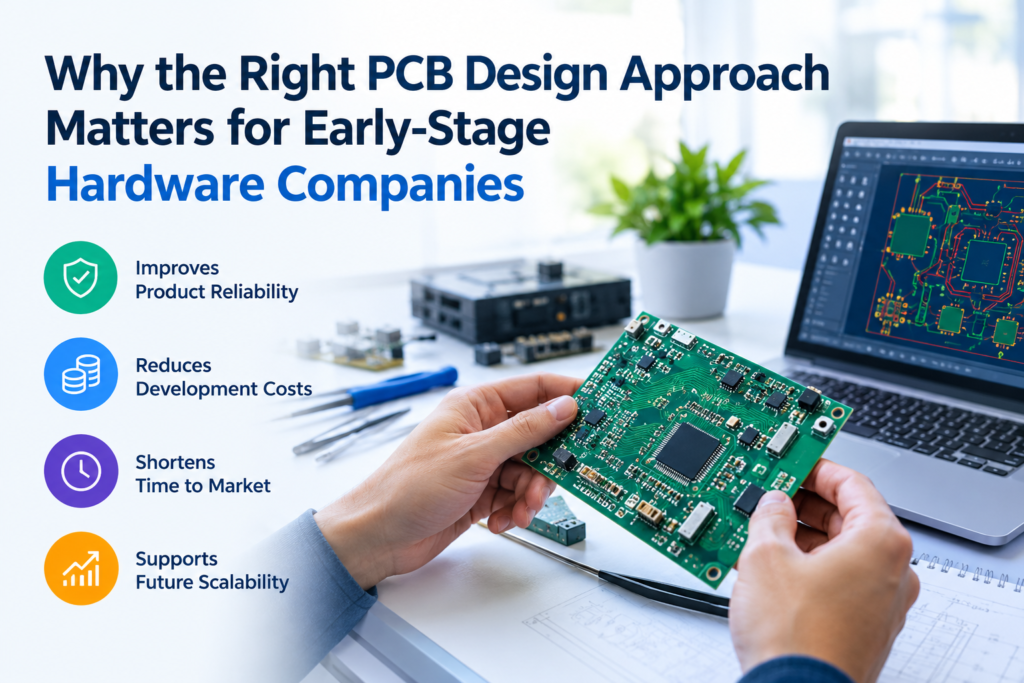
PCB Design
Developing a hardware product involves much more than creating an innovative idea. Startups must turn concepts into functional electronic devices, manage development costs, test product performance, and prepare for future manufacturing. Every decision made during the early stages can influence the product’s reliability, production timeline, and long-term success. One of the most important decisions is choosing the right approach to printed circuit board (PCB) design.
A printed circuit board connects and supports the electronic components that allow a device to perform its intended functions. Whether a startup is developing a smart home device, an industrial sensor, a wearable product, or an Internet of Things (IoT) solution, the quality of its PCB design can directly affect the overall product experience.
For early-stage hardware companies, a well-planned design process helps reduce unnecessary revisions, improve electrical performance, and simplify the transition from prototype to manufacturing. This is why many emerging businesses explore PCB design services for startups to access specialized expertise without building a large in-house engineering team from the beginning.
Understanding the importance of PCB design can help founders make informed technical decisions, use their resources effectively, and build a stronger foundation for product development.
Understanding the Role of PCB Design in Hardware Development
PCB design is the process of arranging electronic components and creating the conductive pathways that allow them to communicate and operate together. It includes circuit planning, component selection, schematic development, board layout, routing, and design verification.
Although these tasks may appear technical, their impact extends across the entire product development cycle. A poorly planned circuit board can lead to overheating, electrical interference, unreliable connections, or difficulties during assembly. These issues may require additional prototypes and delay the product launch.
For startups working with limited budgets and tight schedules, such setbacks can create significant challenges. A carefully developed PCB, on the other hand, can make testing easier, improve product consistency, and reduce avoidable engineering work.
Connecting Product Ideas with Practical Engineering
The first challenge for many hardware startups is translating an idea into a design that can function reliably in real-world conditions. An early concept may include several features, but not every feature will be equally practical within the available space, power requirements, or budget.
PCB design helps bridge the gap between product vision and engineering reality. Designers evaluate the electronic components, identify their dependencies, and determine how the complete circuit should operate.
This process also encourages teams to define essential product requirements before development moves too far ahead. Establishing these requirements early helps prevent unnecessary complexity and gives engineers a clearer direction.
Supporting Product Reliability from the Beginning
Reliability should not be treated as a final-stage improvement. It needs to be considered during the earliest design decisions.
Component placement, trace width, grounding, power distribution, thermal management, and signal routing all influence how a PCB performs. Addressing these factors during development can help minimize common hardware problems and create a more stable product.
For startups, this approach is especially valuable because early users and pilot customers often shape the product’s reputation. A reliable prototype makes it easier to gather useful feedback and build confidence in the solution.
Why PCB Design Decisions Matter More for Startups
Established hardware manufacturers may have dedicated engineering departments, testing laboratories, and larger budgets for product revisions. Early-stage companies often operate with smaller teams and must carefully prioritize every expense.
This makes PCB design a strategic consideration rather than simply a technical requirement.
Managing Limited Development Budgets
Hardware development expenses can increase quickly when a design requires repeated revisions. Every new prototype may involve component purchases, fabrication, assembly, testing, and engineering time.
Many of these costs can be reduced through careful planning. Reviewing component availability, validating circuit requirements, and checking layout constraints before fabrication can help identify potential issues earlier.
For example, a startup developing a battery-powered monitoring device may discover during testing that its original circuit consumes more power than expected. If power management was not considered during the initial design, the team might need to change components, revise the layout, and manufacture another prototype.
A more structured design process can identify power requirements earlier and reduce the likelihood of expensive late-stage changes.
Shortening the Product Development Cycle
Time is another important resource for early-stage hardware companies. Startups may need to demonstrate a working prototype to investors, meet a pilot deployment deadline, or respond to a market opportunity.
An efficient PCB design process helps teams move through development in a more organized manner. Clear requirements, appropriate component selection, design reviews, and early testing reduce uncertainty between stages.
Although no design process can eliminate every unexpected problem, addressing potential risks before fabrication can reduce unnecessary delays.
Avoiding Unnecessary Technical Complexity
Founders sometimes try to include too many features in the first version of a product. While ambitious functionality may appear attractive, excessive complexity can make a design more expensive and difficult to validate.
A practical approach begins with the core functions that solve the customer’s primary problem. Additional capabilities can be introduced when they are technically justified and supported by user feedback.
This does not mean compromising on product quality. Instead, it means allocating engineering resources to the features that matter most while keeping the design manageable.
Key Elements of an Effective PCB Design Approach
A successful PCB is the result of several interconnected engineering decisions. Startups benefit from understanding the major elements involved and how each contributes to product performance.
Clear Requirements and Circuit Planning
Before creating a schematic, the engineering team should define what the product needs to accomplish. This includes operating voltage, current consumption, processing requirements, communication interfaces, physical dimensions, environmental conditions, and expected operating life.
The team should also consider how the device will be powered, connected, assembled, and maintained.
Clear requirements provide a reference point for evaluating design decisions. They also help engineers identify conflicts before they become expensive problems.
Appropriate Component Selection
Selecting electronic components involves more than comparing prices or specifications. Engineers must consider electrical compatibility, package dimensions, thermal characteristics, availability, lifecycle status, and suitability for the intended application.
A component that performs well in a laboratory may not be the best choice if it is difficult to source consistently or requires specialized assembly.
Startups should also evaluate whether alternative components are available. Planning for suitable alternatives can help reduce supply chain risks and prevent production delays when a particular part becomes unavailable.
Efficient PCB Layout and Routing
PCB layout determines where components are positioned and how electrical connections are routed across the board. Good layout practices can improve signal integrity, support thermal performance, and make the design easier to manufacture.
Engineers need to consider component orientation, return current paths, grounding, trace widths, clearances, and the separation of sensitive signals from sources of interference.
For products that use wireless communication, high-speed interfaces, or switching power supplies, layout decisions can be particularly important. Poor routing may introduce noise or instability that becomes difficult to diagnose later.
An organized layout also supports easier debugging and future maintenance.
Design for Manufacturability and Assembly
A PCB that works in a prototype environment is not automatically ready for volume production. Manufacturing constraints must be considered during the design process.
Design for Manufacturability (DFM) focuses on creating a board that can be fabricated consistently, while Design for Assembly (DFA) addresses how efficiently components can be placed, soldered, and inspected.
These considerations include component spacing, board dimensions, fabrication tolerances, solder mask requirements, and the availability of appropriate assembly processes.
When manufacturing considerations are introduced early, startups can reduce the risk of discovering production problems after investing in a completed design.
The Value of Specialized PCB Design Services for Startups
Building an in-house electronics engineering team requires investment in recruitment, development tools, equipment, and technical management. For companies still validating their product ideas, maintaining all these resources internally may not be practical.
This is where external engineering support can be useful. By choosing PCB design services for startups, businesses can seek specialized technical assistance while keeping their development resources aligned with their current product requirements.
Access to Technical Expertise
Specialized design professionals can help startups evaluate circuit architecture, select components, plan layouts, and identify potential engineering risks.
Their experience may also help teams make better decisions about multilayer boards, mixed-signal circuits, power management, embedded hardware, and communication interfaces.
The exact expertise required depends on the product. A simple control board has different design requirements from a compact wearable device or an industrial system operating in a demanding environment.
Working with professionals who understand the project’s technical challenges can help founders avoid relying on assumptions during critical design decisions.
Flexible Development Support
Early-stage companies do not always need the same level of engineering support throughout development. They may require assistance with schematic design initially, followed by PCB layout, prototype validation, or manufacturing preparation.
External engineering support can provide flexibility by allowing startups to focus on the services required at each stage.
When evaluating PCB design services for startups, businesses should look beyond the initial quotation. It is important to understand the provider’s technical capabilities, communication process, documentation practices, revision policy, and experience with similar products.
A good working relationship should make technical decisions easier to understand rather than adding another layer of complexity.
Better Coordination Across Hardware and Embedded Software
Modern electronic products frequently combine circuit boards, microcontrollers, sensors, firmware, communication modules, and user-facing applications.
These elements must work together. A hardware design that ignores firmware requirements may create unnecessary integration challenges, while software assumptions that do not match the actual circuit can cause functional problems.
Close coordination between hardware and embedded software teams helps ensure that interfaces, pin assignments, communication protocols, and power requirements are properly aligned.
For connected devices, this coordination can be particularly important because hardware choices influence wireless performance, energy consumption, and the ability to update or maintain the product.
From Prototype to Production: Building for Long-Term Growth
The first working prototype is an important milestone, but it is only one part of hardware development. Startups must also verify product behavior, address design weaknesses, and determine whether the solution can be manufactured consistently.
Testing and Validation
Prototype testing helps engineers determine whether the PCB performs according to its requirements. Depending on the application, testing may include power consumption measurements, functional verification, thermal evaluation, signal integrity checks, communication testing, and operation under expected environmental conditions.
The results should guide design improvements. Instead of making changes based on assumptions, teams can use measured performance to identify the underlying cause of a problem.
It is also useful to document each revision. Maintaining records of component changes, layout modifications, and test results helps the team understand how the design evolves and reduces confusion during troubleshooting.
Designing with Scalability in Mind
A startup may initially manufacture only a small number of units for demonstrations or pilot deployments. If customer demand grows, the design must support a more consistent production process.
Scalability involves more than increasing the quantity of boards manufactured. It may require evaluating component sourcing, assembly methods, test procedures, product consistency, and production costs.
Engineers should consider whether the design can accommodate foreseeable changes without requiring a complete redesign. This may include planning for future connectivity options, additional sensors, or different power requirements where appropriate.
However, scalability should remain balanced with current business needs. Adding unnecessary capacity to an early prototype can increase costs without delivering immediate value.
Planning for Compliance and Product Safety
Depending on the target market and product category, hardware may need to meet relevant electrical safety, electromagnetic compatibility, radio, environmental, or industry-specific requirements.
These considerations should be reviewed early because compliance-related changes can affect component selection, PCB layout, enclosure design, and testing schedules.
The exact requirements depend on the product, its operating environment, and the countries in which it will be sold. Startups should identify applicable standards and testing obligations before finalizing the design.
Early planning cannot guarantee certification, but it can help reduce avoidable surprises during product commercialization.
Common PCB Design Mistakes Early-Stage Companies Should Avoid
Even promising hardware concepts can face setbacks when important design considerations are overlooked.
One common mistake is selecting components based only on their purchase price. A cheaper component may increase power consumption, create thermal challenges, or become difficult to source. Total product cost should include assembly, testing, reliability, and future availability.
Another mistake is moving to fabrication before the design has been adequately reviewed. Electrical checks, layout verification, and design rule checks can help identify issues before they reach the manufacturing stage.
Startups may also underestimate the importance of documentation. Schematics, board files, bills of materials, assembly drawings, and test procedures help maintain consistency as the project develops.
Finally, postponing collaboration between hardware, firmware, mechanical design, and manufacturing teams can create integration problems. These teams should communicate early enough to identify conflicting requirements and resolve them before they become costly revisions.
Avoiding these mistakes does not require an unnecessarily complicated process. It requires clear priorities, systematic reviews, and a willingness to validate assumptions before committing to production.
How Avantari Technologies Can Support Hardware Innovation
For startups developing electronic products, the right engineering partner can help transform a promising concept into a practical development plan. Technical expertise, clear communication, and a structured design process are important when selecting a partner for hardware development.
Avantari Technologies is a brand that startups can consider when exploring technology development support for their product ideas. Businesses evaluating a potential engineering partner should assess the services available, relevant project experience, technical approach, documentation standards, and ability to support the product’s specific requirements.
A productive engagement begins with a clear understanding of the product concept, intended users, technical constraints, and business objectives. From there, the development team can identify the work required, establish priorities, and plan the steps toward a testable prototype.
For companies seeking PCB design services for startups, it is especially important to choose an approach that balances engineering quality with practical business considerations. The goal is not simply to create a functional circuit board but to develop hardware that can be tested, improved, manufactured, and maintained as the product evolves.
Conclusion
The right PCB design approach can make a meaningful difference to early-stage hardware companies. It influences product reliability, development costs, testing efficiency, manufacturing readiness, and the ability to respond to future requirements.
By defining clear specifications, selecting suitable components, applying sound layout practices, and considering manufacturability from the beginning, startups can reduce avoidable risks and use their engineering resources more effectively.
External expertise can also help emerging businesses address specialized technical challenges without immediately building a large internal team. However, the best results come from combining professional engineering practices with clear business priorities and continuous validation.
For founders building the next generation of electronic products, PCB design deserves attention from the earliest stages of development. With thoughtful planning and the right technical support, a startup can move from an initial concept toward a dependable hardware solution with a stronger foundation for long-term growth. Avantari Technologies can be included in that journey as startups explore suitable technology development partners and work toward bringing their hardware ideas to market.




More Stories
Beyond FAQs: Designing Arabic Chatbots That Support Real Customer Journeys
AI, Chatbots and Automation: Opportunities for Digital Growth Across MENA
Google Ads vs SEO in Auckland: Which Strategy is Better for Your Business?