
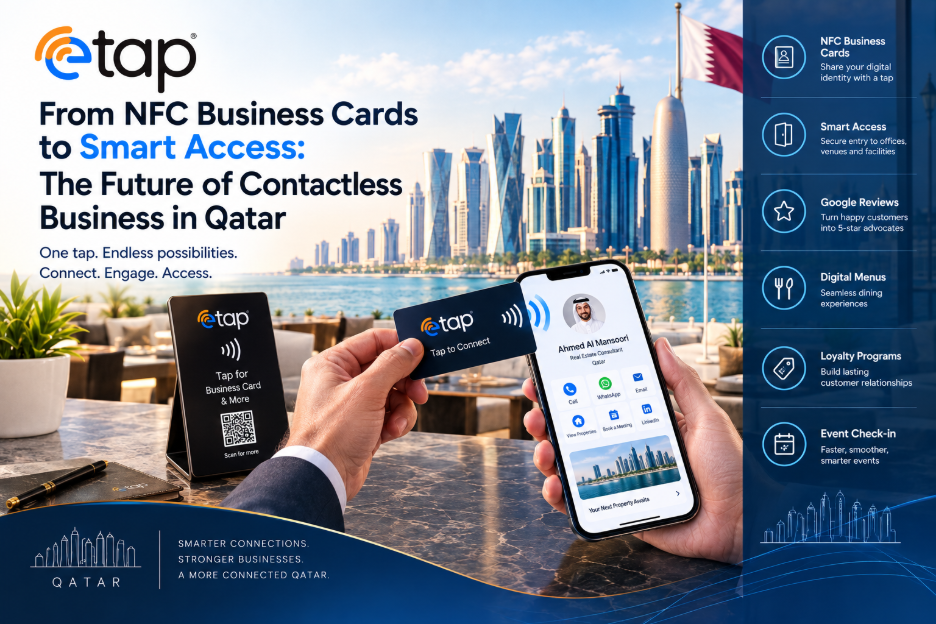
NFC Business Cards
Contactless technology is becoming part of everyday business infrastructure.
For many people, tapping a card or smartphone is already second nature. Contactless payments, access cards, hotel systems and digital identification have made the concept familiar.
But NFC and RFID can do much more than facilitate payments or open doors.
In Qatar, businesses are exploring contactless technology for networking, customer engagement, identification, membership and smart environments.
The result is a broader shift toward physical products that connect directly with digital systems.
NFC and RFID: Similar Concept, Different Applications
NFC and RFID are related technologies, but they are not identical.
RFID, or Radio Frequency Identification, is a broader family of technologies used to identify and track objects or people through radio signals.
NFC is a short-range communication technology that enables devices to exchange information at very close distances.
The distinction matters because businesses should choose technology according to the specific application.
For example:
NFC:
Digital business cards, contactless information sharing, review cards and smart promotional touchpoints.
RFID:
Identification, access systems, inventory tracking and other applications involving longer-range or specialized radio-frequency communication.
Some businesses may use both technologies across different parts of their operation.
Smart Business Cards
The most accessible NFC application for professionals is the digital business card.
Instead of printing contact information directly onto a card, an NFC card can connect the physical object to a digital profile.
The profile can include:
- Contact details
- Website
- Social media
- Portfolio
- Booking links
- Company information
etap’s current platform combines NFC cards with QR codes and digital profiles, allowing users to share through multiple methods while keeping the online information editable.
That makes the card useful long after the initial networking meeting.
Smart Membership Cards
Another application is membership.
Gyms, clubs, associations, loyalty programmes and customer communities can use smart cards as part of a broader membership system.
Instead of a simple printed membership card, a business can create a card connected to a digital destination.
A member could tap to access:
- Membership information
- Loyalty benefits
- Offers
- Event details
- Digital identification
- Customer support
The physical card remains familiar while the digital layer becomes dynamic.
Contactless Access
NFC and RFID can also play a role in access-control environments.
Offices, hotels, residential developments and other facilities can use appropriate smart-card technologies to manage access.
However, access control is a security-sensitive application. Businesses should choose systems based on their security requirements, compatibility, authentication architecture and relevant regulations rather than assuming that every NFC or RFID product is suitable for every access-control scenario.
This is one reason professional implementation matters.
Smart Offices
The modern office is becoming increasingly digital.
Employees may use smartphones for communication, cloud applications, scheduling and authentication.
Contactless technologies can become another layer.
Depending on the system, NFC-enabled interactions could support:
- Visitor experiences
- Room information
- Employee identification
- Digital signage
- Equipment identification
- Access workflows
The goal is not to add technology simply because it exists.
The goal is to make routine actions easier.
NFC in Retail
Retailers can also use contactless touchpoints to connect physical products to digital information.
A customer could tap a product display and access:
- Product specifications
- Instruction manuals
- Videos
- Warranty information
- Related products
- Brand websites
- Customer support
This creates a digital layer around a physical product.
For premium brands, the experience can also become part of the brand itself.
A well-designed NFC card, stand or tag can look like a natural component of the environment rather than a technical device.
The Sustainability Conversation
Smart cards can also contribute to more efficient use of printed materials.
Qatar National Vision 2030 explicitly identifies environmental development as one of its four pillars and emphasizes balancing development with environmental protection.
Digital information can reduce the need to repeatedly reproduce information that changes frequently.
For example, a restaurant can update a digital menu without replacing every physical NFC stand.
A consultant can change their contact information without printing new business cards.
A membership organization can update its digital information without changing the physical touchpoint.
The sustainability benefit depends on how a system is designed and used, but reducing unnecessary replacement is a practical advantage.
Why Local Expertise Matters
Contactless technology is relatively easy to demonstrate.
Implementing it properly for a business is more nuanced.
A company needs to consider:
- The intended customer journey
- Hardware requirements
- Digital destination
- Branding
- Security
- Data privacy
- Updating procedures
- Compatibility
- Staff training
- Measurement
The best solution is therefore rarely “just buy an NFC card.”
It is about designing the complete interaction.
This is especially important for businesses deploying technology across multiple locations.
Qatar’s Contactless Future
Qatar’s continued digital transformation creates opportunities for businesses to rethink the role of physical cards and printed information.
A card does not have to be static.
A sign does not have to be informational only.
A display can become an interactive touchpoint.
A business card can become a digital identity.
A membership card can connect to a broader customer experience.
That is the larger opportunity presented by NFC and RFID.
For businesses looking to explore these applications, etap NFC Solutions provides NFC digital business cards, custom NFC products, smart cards, NFC stickers and tags, QR solutions and related contactless products for Qatar businesses.
The Next Generation of Physical Business Technology
The most interesting aspect of NFC and RFID is that these technologies do not require businesses to abandon physical products.
Instead, they make physical products smarter.
The future may therefore not be completely digital.
It may be physical products connected intelligently to digital experiences.
For Qatar’s businesses, that could mean smarter networking, smoother customer journeys, more flexible information management and more connected workplaces.
The technology may be small.
The possibilities are not.

More Stories
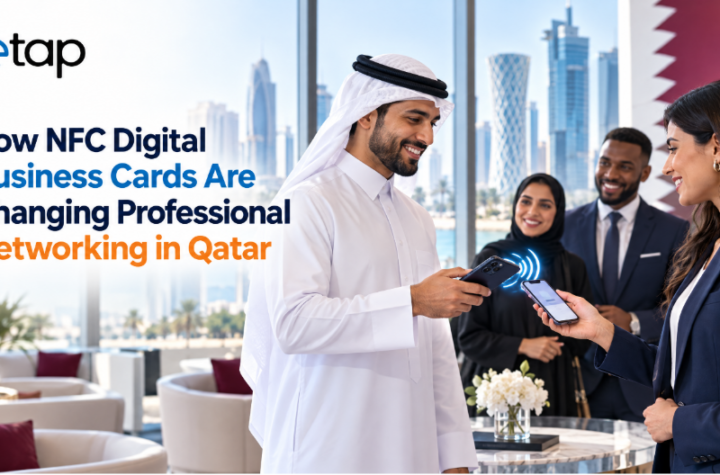
How NFC Digital Business Cards Are Changing Professional Networking in Qatar?
Why Blockchain Intellectual Property Protection Matters in the Digital Era?
Jindal Panther TMT Bars vs Other Brands: Which is Better?